Content · revive your archive

Tired posts, revivedwith receipts.

reads what the page already ranks for · locks those sections · cannot publish without you
  • It reads the rankings before it reads the article — every query that exact URL currently ranks for, from your own Search Console data.
  • Sections carrying a ranking query are locked — not discouraged, not deprioritised. The rewrite tool refuses the edit and says why.
  • Every failure falls toward “leave it alone” — a section it couldn’t classify, a model that errored, a mark it didn’t recognise: all default to locked.
  • It has no publish button — the agent is handed reads, one staged edit and one finalize. Publishing is a separate step that only you can take.
  • One click back — a published refresh rolls back to what was there before.
a real refresh · shopbezza.com · 37 ranking queries

Ultimate Romper Roundup: 2026’s Cozy Indoor Trends

25 sections · 13 locked · 3 add-only · 9 free to rewrite

  • lockedElevate Your Indoor Style with Chic Rompers
  • freeTable of Contents
  • freeFeatured Collections
  • lockedJumpsuits and Rompers
  • freeNew Arrivals
  • lockedEmbrace Comfort and Style with the Latest Womens Romper Suit Trends
  • lockedIndoor Fashion Favorites: Rompers Edition
  • lockedAll My Days Colorful Romper
  • lockedSun-Kissed Serenity Belted Romper
  • add onlyKiss Me Again Coral One Shoulder Ruffle Cropped Jumpsuit
  • freeCome Back Later Ruffle One Shoulder Bodysuit
  • add onlyStyle is Self-Expression One Shoulder Jumpsuit
  • locked2026’s Top Picks for Comfort and Style: Women’s Rompers
  • add onlyWhat womens romper suit are trending?
  • lockedHow to choose the right womens romper suit?
  • lockedFrequently Asked Questions
  • freeJoin our Newsletter

abridged — 17 of this article’s 25 sections

The article ranks 4.9th for “are rompers still in style 2026” (399 impressions) and 5.4th for “are rompers in style 2026”. The sections carrying those answers are the ones marked locked.

How it works

The rankings are read before the article is.

The single biggest risk in refreshing a declining post is that the rewrite kills the rankings the post still has. Everything below exists to make that outcome structurally difficult rather than merely unlikely.

  1. 01

    Find the candidates

    Posts whose traffic is sliding — surfaced to you, not acted on.

  2. 02

    Snapshot the rankings

    Every query this URL ranks for, with its impressions, clicks and position.

    Automatic check
  3. 03

    Split and mark

    The article is cut into sections; each is marked locked, add-only or free.

    Automatic check
  4. 04

    Rewrite what’s allowed

    The agent works within the marks. It cannot edit its way past them.

  5. 05

    You publish it

    Or you don’t. The draft waits; nothing reaches your storefront on its own.

    Merchant gate
  • every section is marked — the classifier caps what it reads, never what it protects
Three marks

A contract, not a hint.

Each section gets one of three marks, and the marks are enforced by the tools the agent is given rather than by instructions in its prompt. A locked section isn’t a section the model has been asked politely to avoid — it is an edit the software refuses to accept.

The add-only rule is the interesting one. It’s checked against the rendered text: whatever the section said before must still be readable, word for word, at the start of what it says now. Hiding the original inside a comment or a script tag doesn’t satisfy it, because the check strips those first.

MarkThe agent mayEnforced
Lockedthis section carries a query the page ranks forNothingrefused
Add onlyuseful, but load-bearingAppendprefix check
Freeno ranking query depends on itRewriteunrestricted
The part worth trusting

Every way this can go wrong ends with your post left alone.

Safety systems are only worth anything in the cases nobody planned for. So the classification is built to fail in one direction — the direction where nothing happens to a section that might be earning you traffic.

  • If

    the classifier returns a mark nobody recognises

    the section is locked

  • If

    it skips a section and says nothing about it

    the section is locked

  • If

    the article is long enough that some sections aren’t sent

    those sections are locked

  • If

    the model fails outright, or returns nonsense

    every section is locked

  • If

    it returns two different marks for one section

    the stricter one wins

  • And if

    nothing can safely be changed at all

    you get no draft, not a bad one

What it can reach

It is reading your old blog posts.

That’s worth thinking about for a second. An AI agent is being pointed at years of text written by other people, some of it copied from elsewhere, any of which could contain a sentence written to hijack an agent that reads it.

The defence isn’t a filter that tries to spot those sentences. It’s that there is nothing on the other side to hijack: the agent holds six read-only tools, one that stages a proposed edit, and one that assembles a draft. No tool writes to your products, your theme, or your storefront. No tool publishes.

What the agent is holding

Read the article
read
Read its Search Console queries
read
Read your brand voice
read
Read your keywords
read
Read possible link targets
read
List your real collections
read
Propose one section edit
staged
Assemble the draft
staged
Publish to your storefront
not given
Edit products or theme
not given
What you get back

A draft, and a decision.

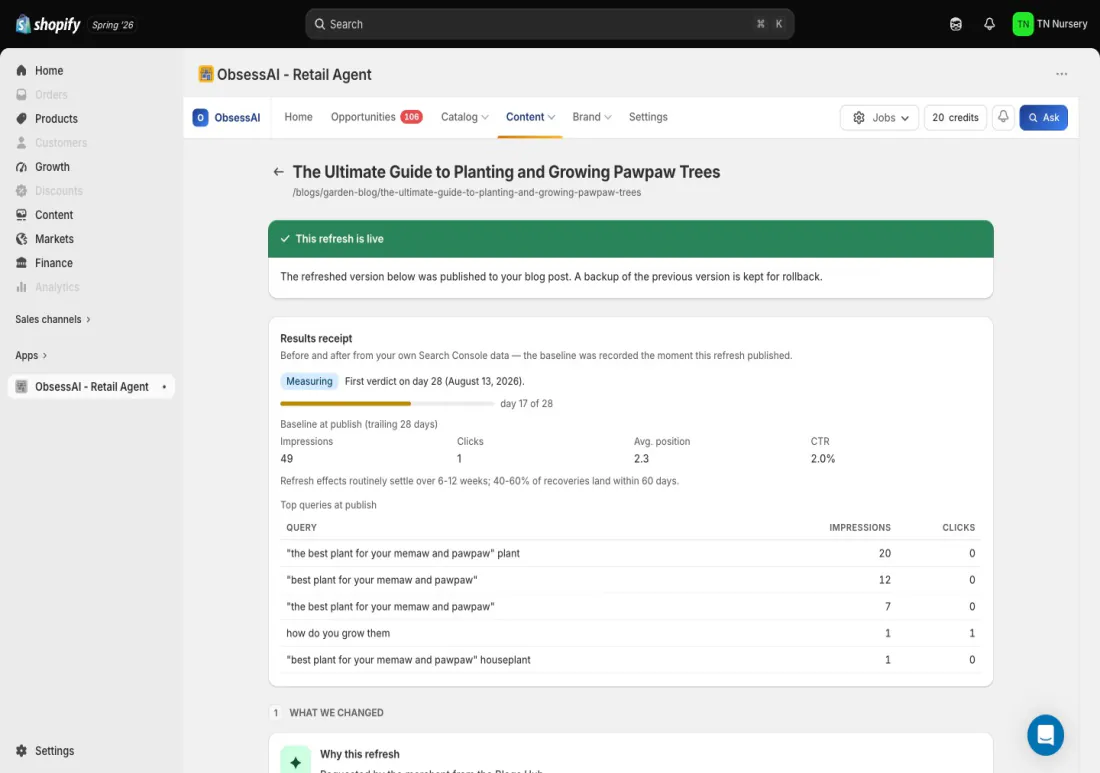
A refresh arrives as a draft waiting for approval — never as a change to your live blog. Read it, publish it, or throw it away. If you publish and then change your mind, the post rolls back to exactly what it was.

And the money follows the same rule: you’re charged when the refresh publishes, not when it drafts. A draft you read and rejected costs nothing.

  • Nothing publishes on a schedule — automatic publishing is switched off, not merely defaulted off
  • One live job per article — the same post can’t be refreshed twice at once
  • Published refreshes roll back — to the exact body that was there before
  • A published refresh

    15 creditsCharged at publish, not at draft
  • A draft you rejected

    freeRead it, discard it, pay nothing
  • Finding the candidates

    freeThe declining-post list costs nothing to look at
Before you ask

The honest answers.

  • Will refreshing a post make it rank better?

    Sometimes. Nobody can promise it, and a refresh can go either way — which is exactly why the parts already earning traffic are the parts it isn’t allowed to touch. The downside is bounded on purpose; the upside isn’t guaranteed.

  • What if the whole post is ranking?

    Then almost all of it gets locked and there is very little to rewrite — and that’s the correct outcome. A post that’s working doesn’t need this feature.

  • Does it touch posts I wrote myself?

    It can, and those are often the best candidates. It doesn’t care who wrote the original; it cares which sections are earning impressions.

  • Can it run on its own?

    It can find candidates and prepare drafts on its own. It cannot publish on its own — that’s a deliberate configuration, not an oversight.

  • What about posts with no rankings at all?

    Then nothing is locked and the whole article is free to rewrite. A post with no traffic has nothing to lose, which the map works out on its own.

Your best article was
published two years ago.

free to look · 15 credits only when you publish one · rolls back if you change your mind