Your bestseller deserves more than a template.
- Built around one product — its own story, its own objections, its own reasons to buy. Not a layout stretched over your whole catalog.
- The buy box is untouchable — price, variants and add-to-cart stay exactly as your theme renders them. The AI composes around them.
- It finds what completes the look — complementary products discovered from your own catalog, not guessed.
- You choose which photos it may use — those photos are the only thing the image model has to work from.
- Live on your storefront — a real theme template for that one product.

Six stages. One of them is locked.
A hero page runs a straight line — no agent loop, no improvisation about what to build. The plan is decided before anything runs, and the commerce-critical part of the page is never in play.
- 01
Answer a few questions
What matters about this product, who it’s for, which of your photos it may use.
- 02
Build the dossier
Every attribute, spec and fact about the product, pulled from your catalog.
- 03
Discover the neighbours
Complementary products and the collections it belongs to, found from your own catalog.
- 04
Lock the buy box
Your theme’s native product section is reserved first. Everything else composes around it.
Never AI-rendered - 05
You approve
The section plan and the quote, before a credit is spent.
Merchant gate - 06
Compose and publish
One pass writes the page; images land deterministically; you preview, then publish.
- the buy box is resolved before composition begins — the page is built around it, never over it
It never touches the part that takes money.
On a product page, one section matters more than all the others: the one with the price, the variant picker and the add-to-cart button. ObsessAI identifies that section in your theme — whichever theme family you’re on — reserves it, and composes the rest of the page around it. It is never rewritten, never regenerated, never dropped.
Everything else on the page is AI-composed and fully reversible. That one section is the theme’s, and stays the theme’s.
| Part of the page | Who writes it | Cost |
|---|---|---|
| Price, variants, add to cartyour theme’s native product section | Never AI | — |
| Product story & detailswritten from the dossier — attributes, specs, materials | Model | 8 cr |
| How to style / use itgrounded in confirmed facts, not invented ones | Model | 8 cr |
| Complete the lookcomplementary products discovered from your catalog | Discovered | 8 cr |
| Questions people askFAQ, with schema | Model | 8 cr |
| Imagerycomposed around the photos you selected | Your photos | 10 cr |
It asks before it writes.
A hero page is worth a minute of your time. Before anything runs, you tell it what this product is really about — and, critically, which of your photographs it is allowed to use. Those photos become the only visual source of truth: generated imagery composes your product into your own scenes, and the product itself stays exactly as photographed.
- What to emphasise — one sentence on tone, audience or angle
- Which photos it may use — your selection, and nothing else
- Your brand backgrounds — optional scenes the product can be composed into
- Language — the page is generated in your shop’s locale
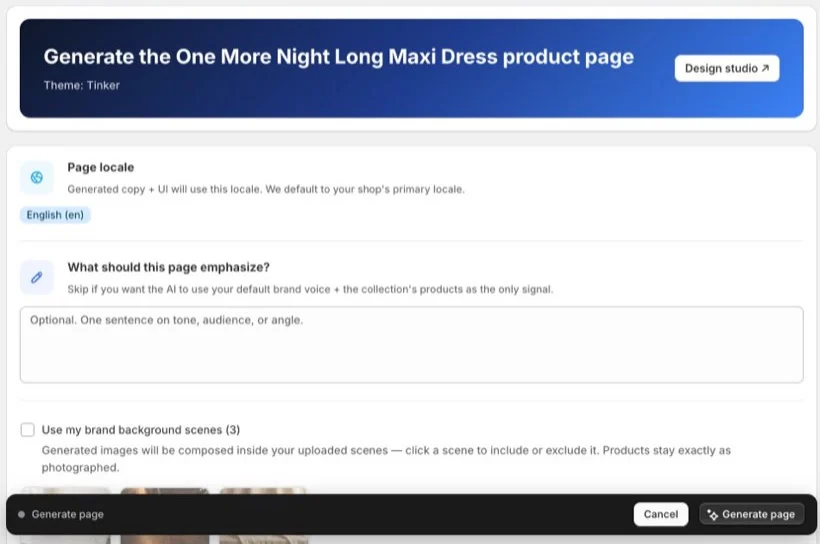
“Products stay exactly as photographed” — the app’s own words on this screen
Priced by the piece. Quoted first.
Page section
8 creditsEach composed section around the buy boxGenerated image
10 creditsComposed around a photo you selectedRefinement
8 creditsRe-composing one section after a chat instruction
The buy box is not a line on this list — it is your theme’s section, so there is nothing to compose and nothing to charge for. Everything you are quoted is a section the AI writes around it.
The honest answers.
Which products should get one?
The ones that carry the store — a bestseller, a flagship, the product a campaign points at. A hero page is a deliberate piece of work for a product that earns it, not something to run across the whole catalog.
Can it break my add-to-cart?
It never touches it. Your theme’s native product section — price, variants, add to cart — is identified and reserved before composition begins, and the AI sections are built around it.
Will it invent specifications?
Copy is written from your product’s own attributes and confirmed facts. Where a fact isn’t confirmed, the page doesn’t claim it.
What about my other products?
A hero is deliberately one page for one product. For the rest of the catalog, product descriptions can be rewritten in bulk — that’s a different feature.
Can I undo it?
Yes. Preview before publishing, roll back after, or unpublish entirely and return to your theme’s default product template.
Give your bestseller
a page of its own.
preview before publishing · roll back anytime · your buy box is never AI-rendered