Every field, rewritten to sell and rank.
- It proposes; you apply — a rewrite is a suggestion sitting next to the original. Your storefront doesn’t change until you decide it should.
- Every factual claim is checked afterwards — a second pass cuts or softens any spec, material, dimension or certification that isn’t supported by something real.
- Your own description outranks everything — a fact you wrote is never deleted. Research supplements what you said; it never overrules it.
- It reads the manufacturer — care instructions, technical specs and brand detail, found on the maker’s own site rather than recalled from memory. Point it at a specific URL if you have one.
- It refuses a thin product — no image, no category or no product type and it won’t run. Better to be told your catalog has a gap than to be handed copy written around one.
- Structured, not a paragraph — a heading, a feature list, a specification table and an FAQ with schema. Around 14,000 characters on the live machine page below.
- A catalog at a time — around 25 products in 25 seconds, measured on our development store. Still one review each before anything ships.
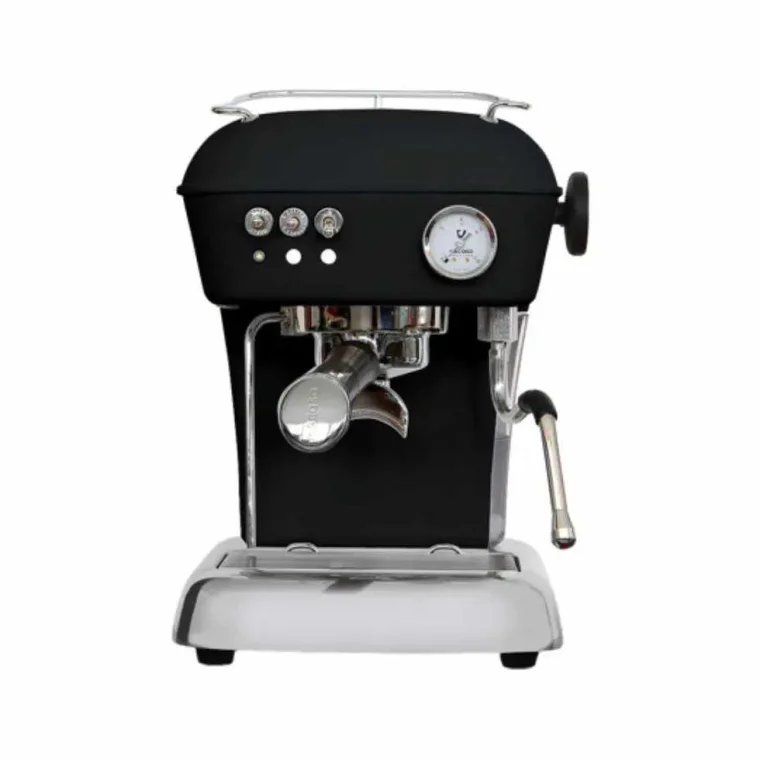
- The product photo
- required
- Product type
- required
- Product category
- required
- The existing description
- the authority
- Title, handle and current SEO fields
- also read
- Vendor
- Ascaso
- A manufacturer URL
- optional
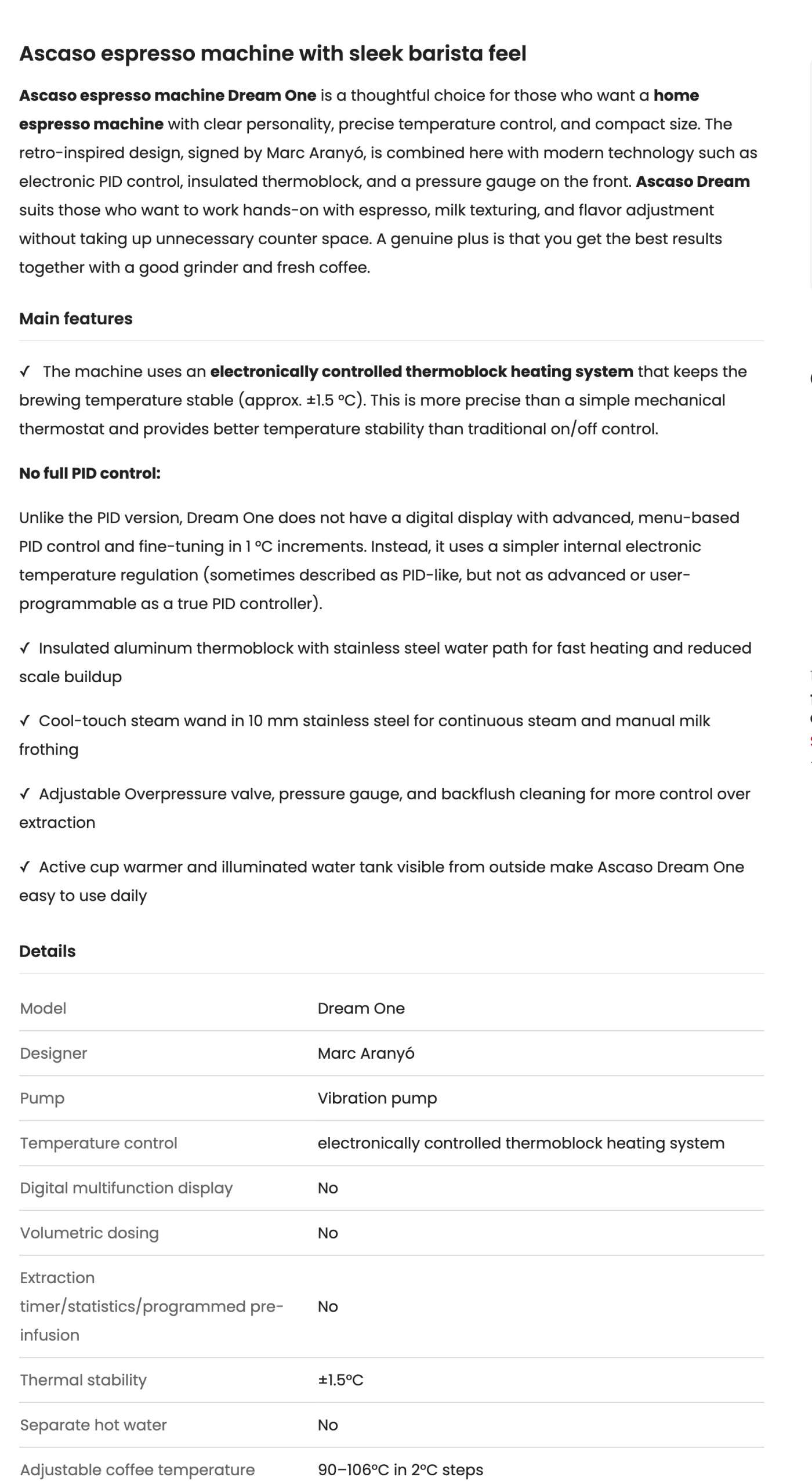
Ascaso Dream One, live on Barista och Espresso today. Everything on the left is what your catalog already holds — the enhancement reads all of it, and won’t run at all without the first three. Everything on the right came out, for five credits.
Write it. Then check it.
The order matters more than it sounds. Asking a model to be careful while it writes produces cautious, lifeless copy. Letting it write well and then auditing every factual claim produces copy that reads like a person and still can’t invent a certification.
- 01
Read what exists
The photo, the type, the category, your description, your current SEO fields, the vendor.
- 02
Research the maker
Specs, care and brand detail from the manufacturer — their site, or a URL you give it.
- 03
Write it properly
Description, SEO title, meta description and alt text, in your store’s voice.
- 04
Ground every claim
A separate pass cuts anything the sources don’t support. It is not a rewriter.
Automatic check - 05
You apply it
Side by side with the original. Save it, or leave it exactly as it was.
Merchant gate
- the grounding pass fails open — if it errors, you get the original text back unchanged rather than a half-audited version
It can’t tell you things it doesn’t know.
This is the part that matters, and it’s the part most tools don’t have. After the description is written, a second model reads it back against three sources — your own description, the manufacturer research, and the product’s real attributes — and removes or softens every verifiable claim that none of them support.
It is deliberately not a rewriter. It makes the smallest edits that fix the problem, preserves your HTML and your language, and leaves subjective language alone. Shorter copy isn’t the goal. Copy that doesn’t assert facts nobody can back up is the goal.
- Your description is the top authority — a fact you wrote survives, always
- Research supplements, never overrules — the maker’s site adds; it doesn’t correct you
- Marketing language is left alone — “beautiful” isn’t a claim anyone has to verify
- Specifications
- Materials
- Dimensions
- Country of origin
- Care requirements
- Certifications
- Health claims
- Safety claims
- Performance claims
- Comparisons
Every one of these is a claim a customer could act on — and a claim a returns policy could be tested against. If the sources don’t support it, it doesn’t ship.
Left untouched
What the pass never edits
Facts your sources do support · subjective and marketing language · your HTML structure · the language the copy is written in.
This is a description on a live storefront.
The block at the top of this page is the first third of it. Here is what the rest contains — and the two sections at the end are the ones a buyer researching a serious home espresso machine actually goes hunting for before they commit.
- 01
A heading that isn’t the product name
“Ascaso espresso machine with sleek barista feel” — what it is and who it’s for, in words a buyer would type.
- 02
Features, including one it doesn’t have
Thermoblock stability to ±1.5 °C, the cool-touch steam wand, the pressure gauge — and, in the middle of them, what this model lacks.
- 03
Around forty specification rows
Designer, pump type, thermal stability, brew temperature range, steam temperature, tank, weight, dimensions, wattage, every filter in the box.
- 04
Care instructions that are actually specific
Clean the dispersion head every 80–100 espressos. 96° alcohol on the casing. Clear the steam wand with a toothpick.
- 05
Who the manufacturer is
Barcelona, 1962, a spare-parts business that became a machine maker — researched from the maker’s own material.
- 06
An FAQ with structured data
Marked up so a search engine can read the questions, not just the page.
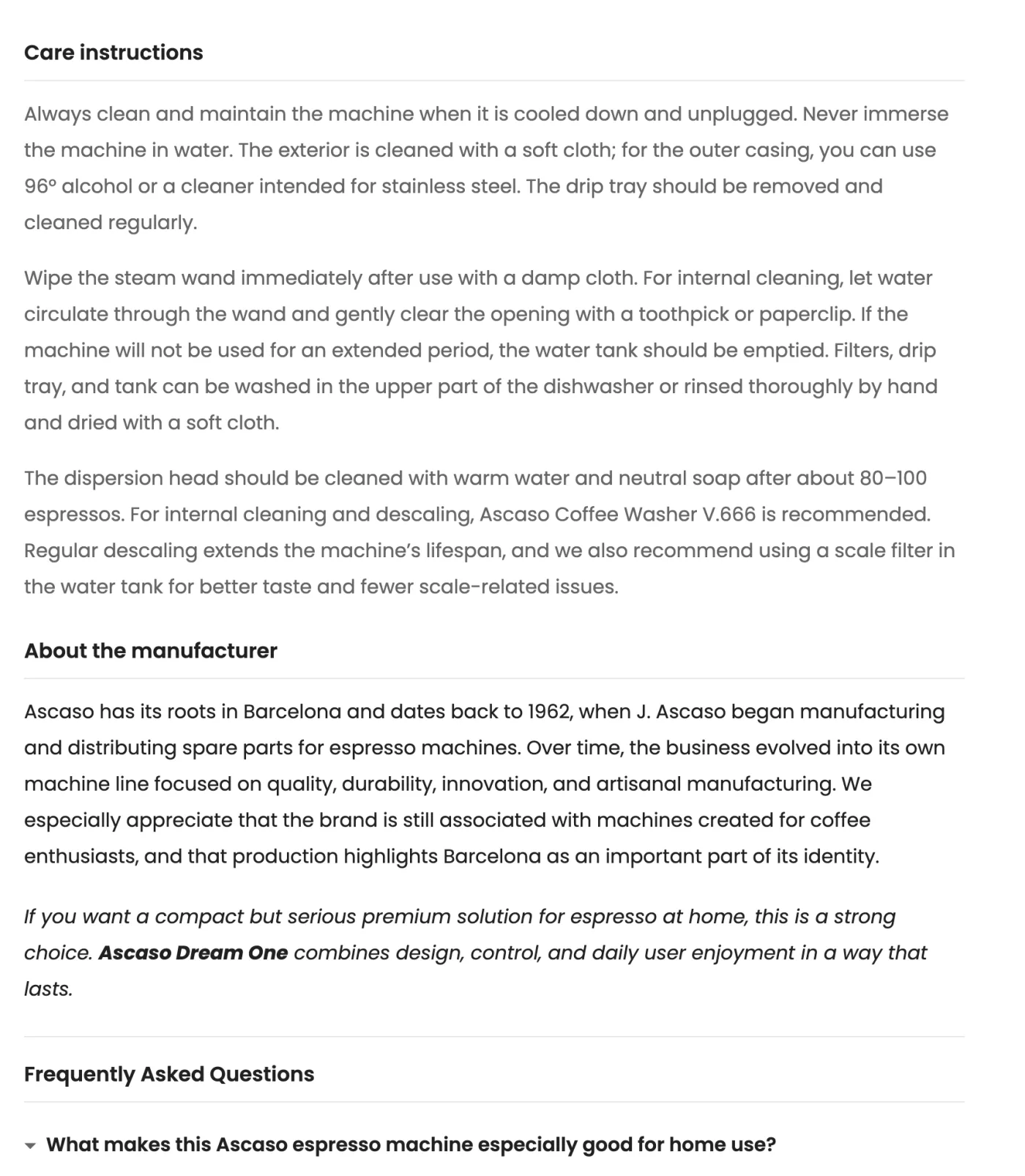
Care instructions and manufacturer background — two sections most product pages simply don’t have.
It tells your customer what it doesn’t know.
Everything on this page about grounding is easy to claim. Here is what it looks like in production, in the feature list of a serious home espresso machine on a real store — the copy volunteering what this model does not do, and naming the pricier sibling that does.
No full PID control: unlike the PID version, Dream One does not have a digital display with advanced, menu-based control and fine-tuning in 1 °C increments.
What it could have done
Left the limitation out. A spec table of everything the machine does have would have looked complete.
What it did
Put it in the feature list, at the top, and named the model that does have it.
Why that matters
The return, the bad review and the support ticket all cost more than the sale. Copy that oversells is a bill arriving later.
on another product the same restraint reads “the exact roast level and bean composition are not specified in the material, so we describe the taste based on available information and no more”
The details you’d have to go and find.
Most of what makes a good product page isn’t in your Shopify catalog. It’s on the maker’s site: the cleaning interval, the descaling product, the company’s history. Writing that for four hundred products is why most catalogs never get it.
So the research is a real step, not a prompt asking a model what it remembers. What comes back is specific enough to be wrong if it were invented — which is the test worth applying to any AI product copy you’re shown.
- Care that names things — 96° alcohol on the casing, a toothpick for the steam wand, the dispersion head every 80–100 espressos
- The descaling product by name — Ascaso Coffee Washer V.666, not “a suitable descaler”
- Who made it — Barcelona, 1962, spare parts before machines
- Cached and reused — researched once per maker, shared across every product from them
What the research returned
- Cleaning interval
- every 80–100 espressos
- Casing
- 96° alcohol, soft cloth
- Steam wand
- wipe immediately, clear with a toothpick
- Descaler
- Ascaso Coffee Washer V.666
- Maker founded
- Barcelona, 1962
- Originally made
- espresso-machine spare parts
cached per manufacturer · researched once, reused across their whole range
Forty rows of specification, from one product.
Thermal stability to ±1.5 °C. Brew temperature adjustable 90–106 °C in 2 °C steps. Steam at 165 °C. A 1.3-litre illuminated tank. 10 kg, 245×345×280 mm, 1050 W. A walnut handle and an aluminium casing. Every filter in the box, listed by gram weight.
None of that is persuasion. It’s the information a buyer making a considered purchase goes looking for — and the reason they either buy from you or open a second tab.
- Designer
- Marc Aranyó
one of the spec rows — the kind of detail nobody writes by hand for a whole catalog
The wrong word is store-specific.
There is no global list of banned words, because the concept doesn’t survive contact with real catalogs. A plant nursery doesn’t want its ground cover described as “invasive” — but “invasive” isn’t a bad word, it’s a bad word there, and a word that’s wrong for a nursery may be exactly right for a hardware store.
So the same pass that grounds the facts also judges the language against what your store actually is and who it actually sells to. It’s a brand judgment made per store, not a filter applied to everyone.
| What it writes | Where it goes | Yours to keep |
|---|---|---|
| The descriptionthe body copy on the product page | Product body | reviewed |
| SEO titlewhat search engines show as the headline | SEO field | reviewed |
| Meta descriptionthe snippet underneath it | SEO field | reviewed |
| Image alt textread by screen readers and image search | Media | reviewed |
| Your price, stock and variantsnothing commercial is in scope | Never touched | — |
Five credits a product.
The same price whether you run one product or the whole catalog, and the research is the only optional line on it.
One product
5 creditsDescription, SEO title, meta description and alt textIn bulk
5 credits eachSame price, run across a selection — around 25 in 25 seconds, measured on our development storeManufacturer research
3 creditsOptional, cached for a week, shared across products from the same maker
A 200-product catalog is 1,000 credits — one pass over everything you sell. That figure is arithmetic on the first price above (200 × 5), not an average of real runs: a run that also researches the makers costs more, and your own total is quoted before it starts.
The honest answers.
Will it change descriptions I wrote myself?
Only if you tell it to save. It generates a proposal that sits beside your original until you apply it — and when it writes, your own wording is treated as the authoritative source rather than something to improve. If you want a product left alone, don’t include it in the run.
Can it invent a certification or a material?
That’s precisely what the grounding pass exists to stop, and it’s why the pass is separate from the writing rather than an instruction inside it. It isn’t infallible — which is why you read the proposal before it ships.
Does it work in my language?
Yes, and the grounding pass preserves whatever language the copy is written in rather than quietly translating it.
What about products with a hero page?
When a product has a published AI page, that page owns the search-facing title and meta, and the enhancement deliberately stops writing them so the two can’t fight over the same fields.
What if I don’t like what it wrote?
Don’t apply it. Nothing has changed on your storefront at that point — the proposal is just a record in the app.
Most catalogs are one
good description and 199 copies of it.
first rewrites in your free trial · read every one before it ships